Durability Prediction System
Our durability prediction system is a computer simulation that predicts the life of concrete structures that can be applied to concrete of various materials and formulations or various deterioration phenomena.

Introduction
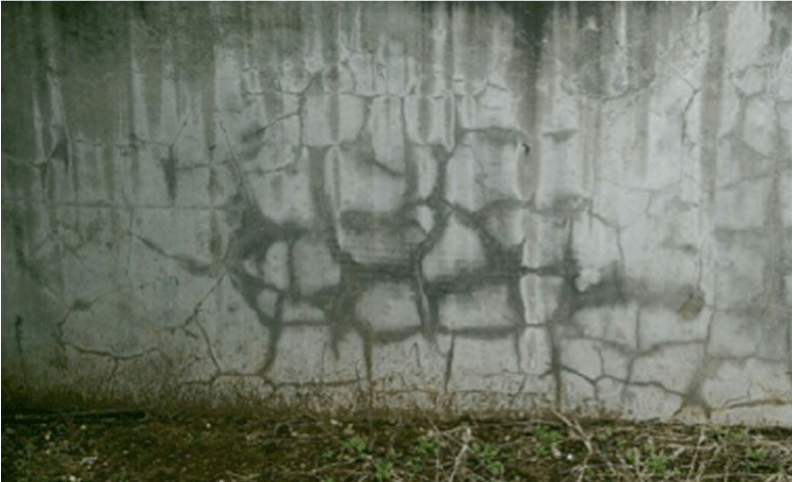
In the context of the increased lifetime of RC structures and the advancement of rational maintenance technology, there is demand for durability prediction technique which supports a variety of degradation phenomena for wide range of materials and the mix proportions of concrete. In order to predict various degradations based on phenomena which have actually occurred, it is necessary to conduct comprehensive analysis for the behavior of diverse chemical factors which contribute to degradation phenomena. Examples include the transfer of ions in the liquid phase existing inside of concrete, the binding of ions caused by hydrates, and the generation/dissolution of hydrates. The Taiheiyo Cement Group has coupled a mass transfer model for multi-species with a thermodynamic phase equilibrium model for hardened cement which enables calculation of the C-S-H solution equilibrium and surface adsorption. By doing so, our company has developed a model for predicting gas-phase, liquid-phase, and solid-phase composition which undergoes temporal change in conjunction with mass transfer.
Overview and Features
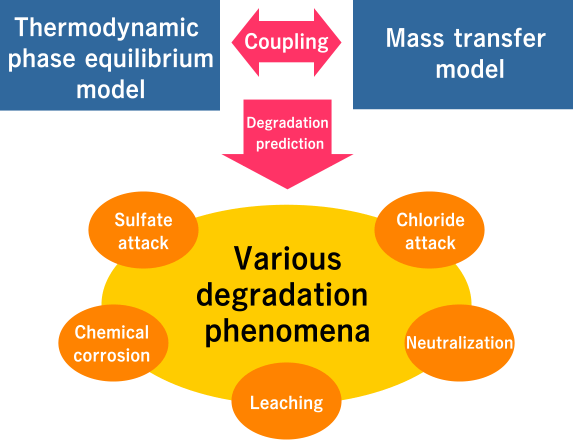
Conventional durability prediction was only able to analyze the behavior of a single degradation factor. For example, the simulation for chloride attack only calculated the movement of chloride ions.
However, inside of actual concrete structures, chloride ions coexist with a variety of other ions. While exerting mutual effect on each other, these ions exchange mass with hydrates. This interaction among ions and hydrates can be calculated using thermodynamic phase equilibrium. Accordingly, in order to accurately predict the movement of mass during a durability simulation, it is essential to create a model for mass transfer which incorporates thermodynamic phase equilibrium.
Our durability prediction system was developed by combining a mass transfer model for multi-species with a phase equilibrium model for hardened cement, thus coupling together reciprocal models. This enables durability simulation which matches actual phenomena.
Compared to conventional durability simulations, our simulation supports a variety of environmental conditions and degradation phenomena. The simulation possesses a high level of versatility which is not restricted by the mixtures of concrete structures or the type of materials.
Supports a vast range of materials and mixtures
By using the thermodynamic phase equilibrium model, this simulation enables calculation of the phase composition required for initial conditions. Calculations are based on the chemical composition of cement, reaction ratio of cement minerals, and the mix proportions of concrete.
In other words, unlike conventional simulations, our simulation is not restricted to certain types of materials or mix proportions. This enables durability prediction for diverse cases with a varied mix proportion, such as different types of portland cement and blended cement containing slag and fly ash.
Supports a vast range of environmental conditions
Conventional durability prediction for chloride attack environment has focused only on chloride as the environmental factor. However, in our simulation, it is possible to input the exact seawater composition as the environmental conditions. This enables the durability prediction to consider the effect of sodium ions, magnesium ions, sulfate ions, and other ions other than chloride ions contained in seawater.
Furthermore, calculations in our simulation also consider the gas phase. Therefore, the simulation can respond to a wide range of environmental conditions which include carbon dioxide and humidity in the atmosphere.
Enables prediction for various degradation phenomena (also supports coupled degradation)
By combining phase equilibrium and the mass transfer model, our simulation supports a wide range of diverse degradation phenomena.
This simulation is able to calculate composition changes in gas, liquid, and solid phases inside of hardened cement by coupling the phase equilibrium model with a mass transfer model which is used for the transfer of many types of species. As a result, the degradation phenomena for which durability prediction can be conducted is not limited to chloride attack; it also includes carbonation, sulfate attack, and a variety of other degradation. In addition, the simulation also supports coupled degradation in which chloride attack and carbonation occur simultaneously.
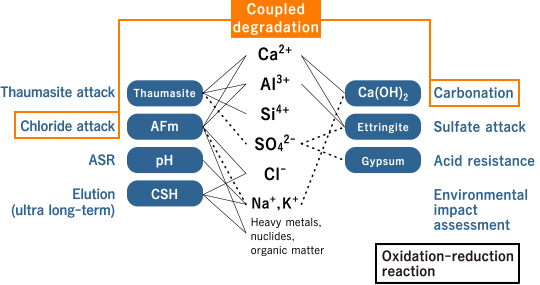
What is coupled degradation?
Coupled degradation is a phenomenon in which multiple forms of degradation occur simultaneously in concrete. Normally, coupled degradation is more severe than when individual forms of degradation occur independently. Accordingly, it is extremely important to focus on coupled degradation when predicting durability.
Coupled degradation consisting of carbonation and chloride attack
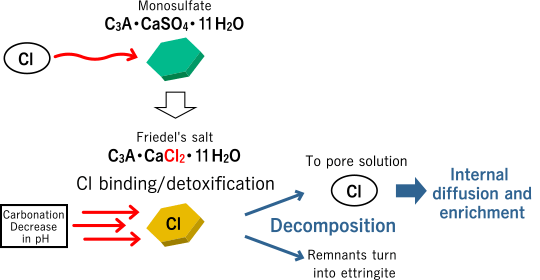
When carbonation and chloride attack occur simultaneously in concrete, the pH of pore solution in the concrete decreases and enrichment of chloride occurs. This generates a higher concentration of chloride inside the concrete than if chloride attack was to occur independently and also causes a decrease in pH. As a result, there is a higher risk of corrosion for rebar installed in the concrete.
Chloride concentration profile inside concrete exposed to carbonation and chloride attach (analyzed using an electron micro probe analyzer)
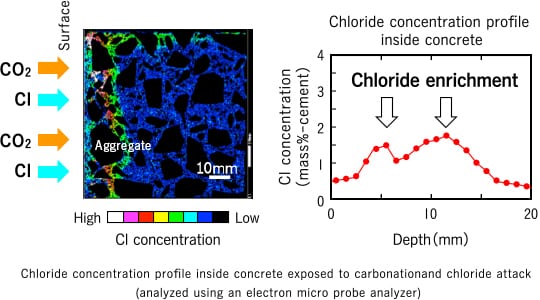
Mechanism of chloride enrichment caused by coupled degradation consisting of carbonation and chloride attack
Chloride enrichment caused by coupled degradation consisting of carbonation and chloride attack occurs when the decrease in pH due to carbonation causes decomposition of hydrates known as Friedel's salt, which are generated when cement components react with chloride. The decomposition of Friedel's salt causes chloride released into pore solution to move to deeper areas of the concrete, thus causing chloride enrichment.
Thermodynamic phase equilibrium model
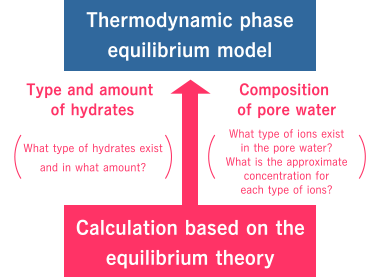
This model uses equilibrium theory as a basis to calculate the chemical species and solid phases in which substances of a certain system exist under given conditions (temperature, pH, redox state, etc.), as well as the approximate amount of those forms.
Mass transfer model
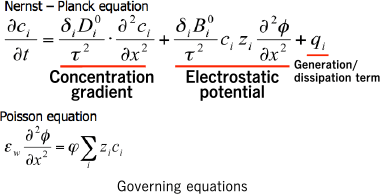
In this simulation, the movement of ions in the liquid phase is determined through numeric calculation using the Nernst-Planck equation and the Poisson equation as the governing equations. The Nernst-Planck equation applies to the conservation of mass, while the Poisson equation applies to the electrostatic potential which occurs in conjunction with transfer.
When performing coupled analysis using the Nernst-Planck equation and the Poisson equation, it is possible to use the finite element method for solutions. Here, the Galerkin method is used for discretization related to space, and the Θ method (Θ = 0.878) is used for discretization related to time.
Results of the thermodynamic equilibrium model are substituted for the generation/dissipation term of the Nernst-Planck equation. This couples the mass transfer model and the thermodynamic phase equilibrium model, thus making it possible to predict temporal changes in gas-phase, liquid-phase, and solid-phase composition.
Application Example
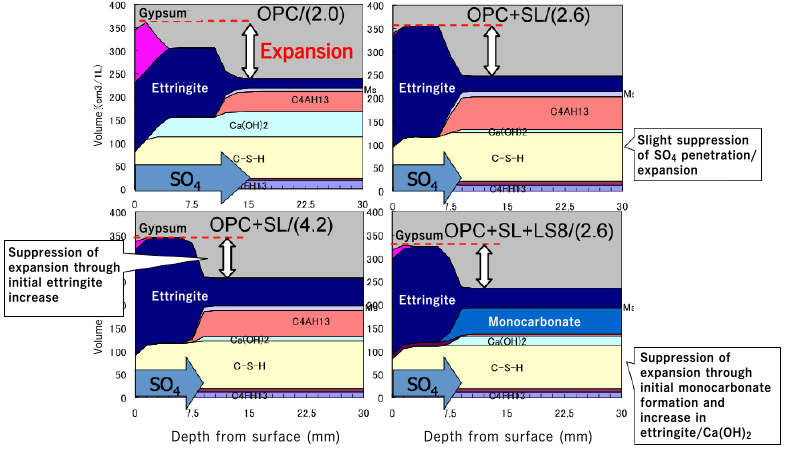
Reproduction of sulfate resistance test
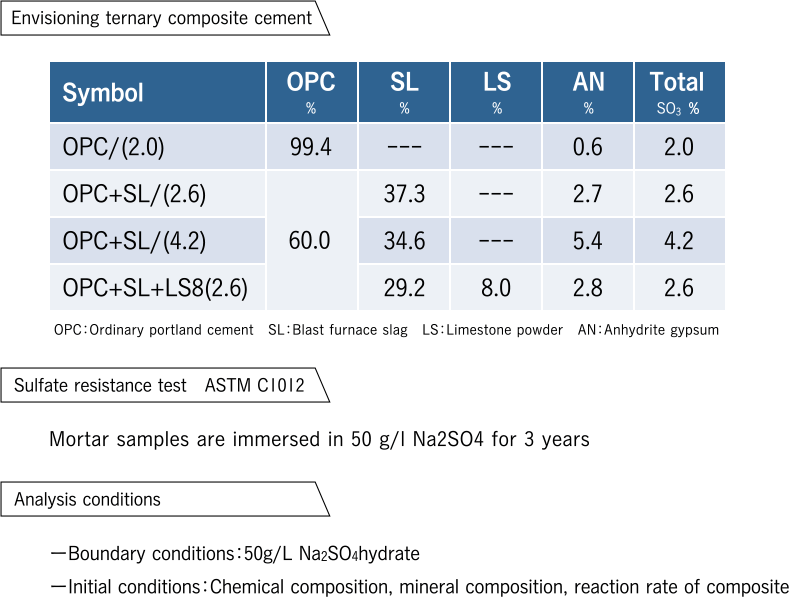
Simulation used to reproduce sulfate resistance test
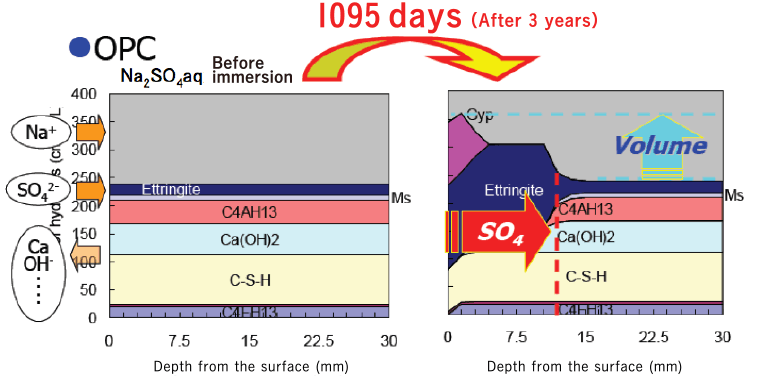
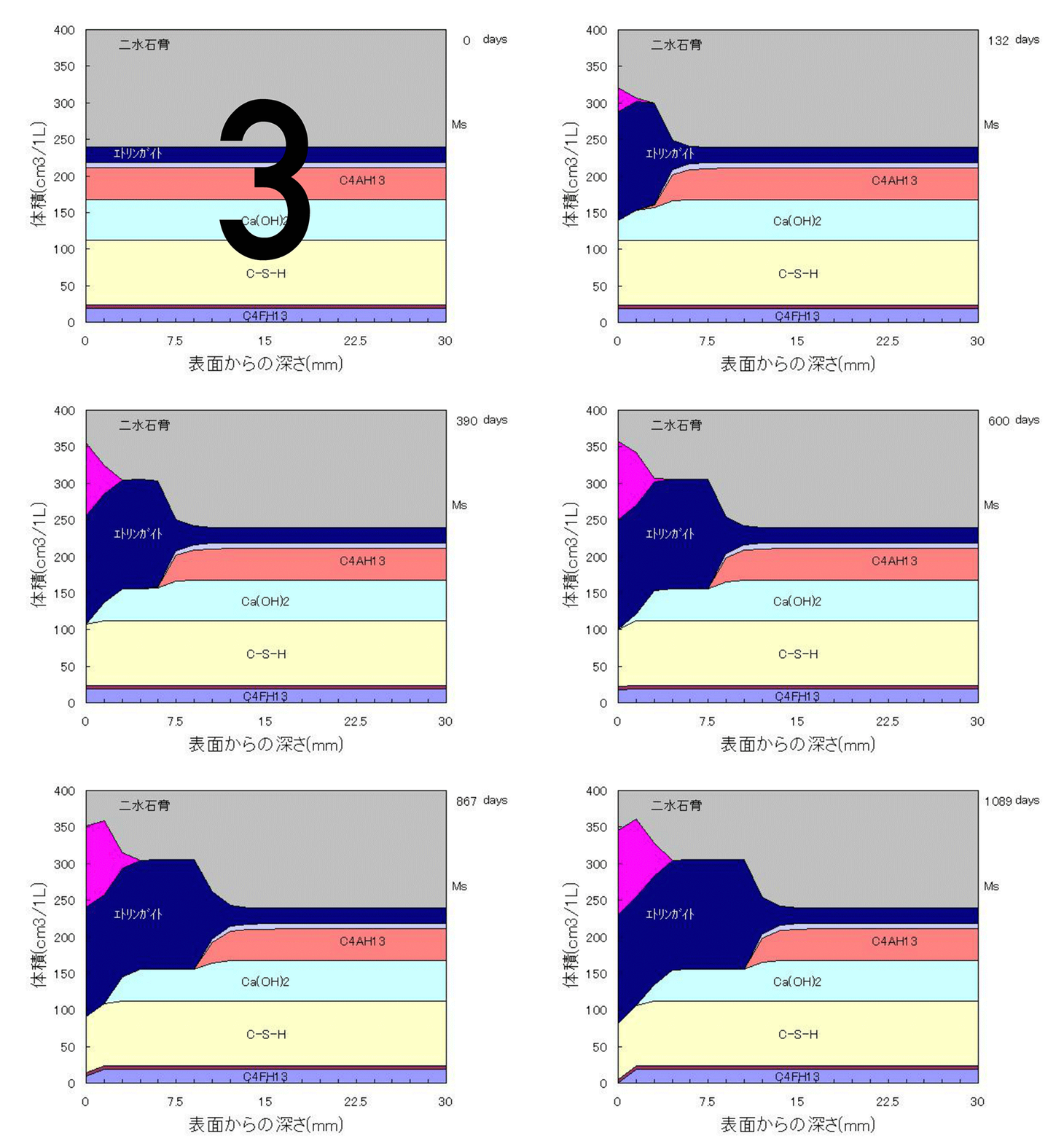
Calculation results
Future Prospects

Moving forward, we will realize innovative durability simulation by fully utilizing the advantages and features of this simulation, and by appropriately combining the analysis technique, commercial products, and construction methods of the Taiheiyo Cement Group in various fields. We will then apply the innovative simulations to new materials development, concrete solutions, and consulting.
Inquiries
If you need any further information regarding the technology, please use this inquiry form to contact us.